
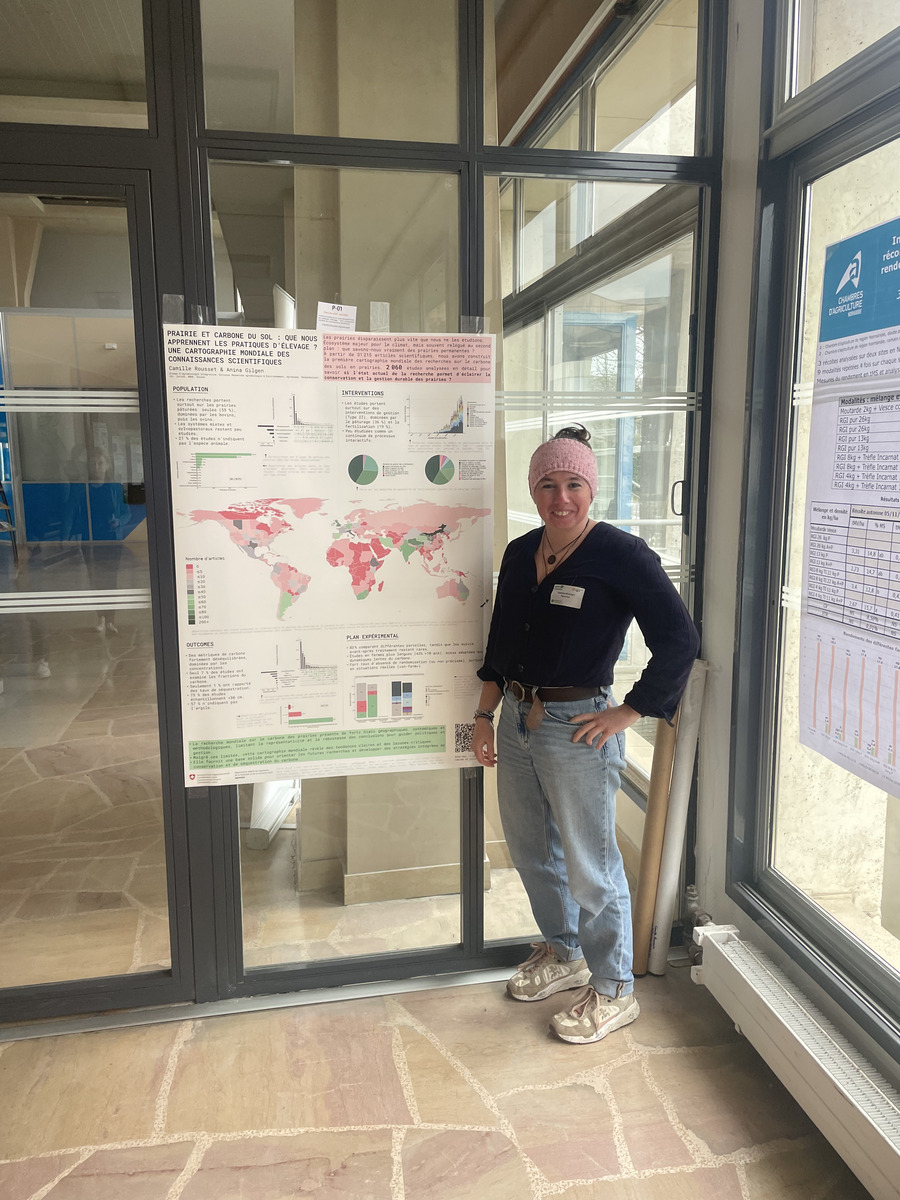
Date: 10-11/03/2026The CarboGrass project was pleased to present the results of its systematic map at the Journées de Printemps, held in Dijon, France, from March 10-12. This conference focused on the role of grasslands and forage systems in the agroecological transition, bringing together researchers and practitioners around the 13 principles of agroecology defined by the FAO. Presentations covered a wide range of topics, from nutrient recycling and knowledge co-creation to biodiversity and input reduction, with particularly strong emphasis on reducing external inputs and enhancing ecosystem functioning. Our poster, Prairies et carbone du sol : que nous apprennent les pratiques d’élevage ? Une cartographie mondiale des connaissances scientifiques (“Soil Carbon and Grasslands: What can livestock management tell us? A Global Evidence Map”), contributed to the soil health dimension of agroecology by mapping the global distribution of scientific studies on livestock management and soil carbon in grasslands. Rather than assessing the effects of practices on soil carbon stocks, this systematic map identifies where research efforts have been concentrated and where important knowledge gaps remain across management practices, regions, and pedoclimatic contexts. Highlighting these patterns helps researchers and policymakers recognize potential research biases and better target future studies to support more balanced and informed grassland management strategies. During the flash talk session, Camille Rousset presented the methodology, timeline, and objectives of the systematic map (see Rousset et al. 2024 for more info), while the poster showcased the main findings and introduced the interactive Shiny app developed to explore the dataset. Scientific publication soon to be followed in Environmental Evidence journal!!
Stable Isotope Meeting 2026
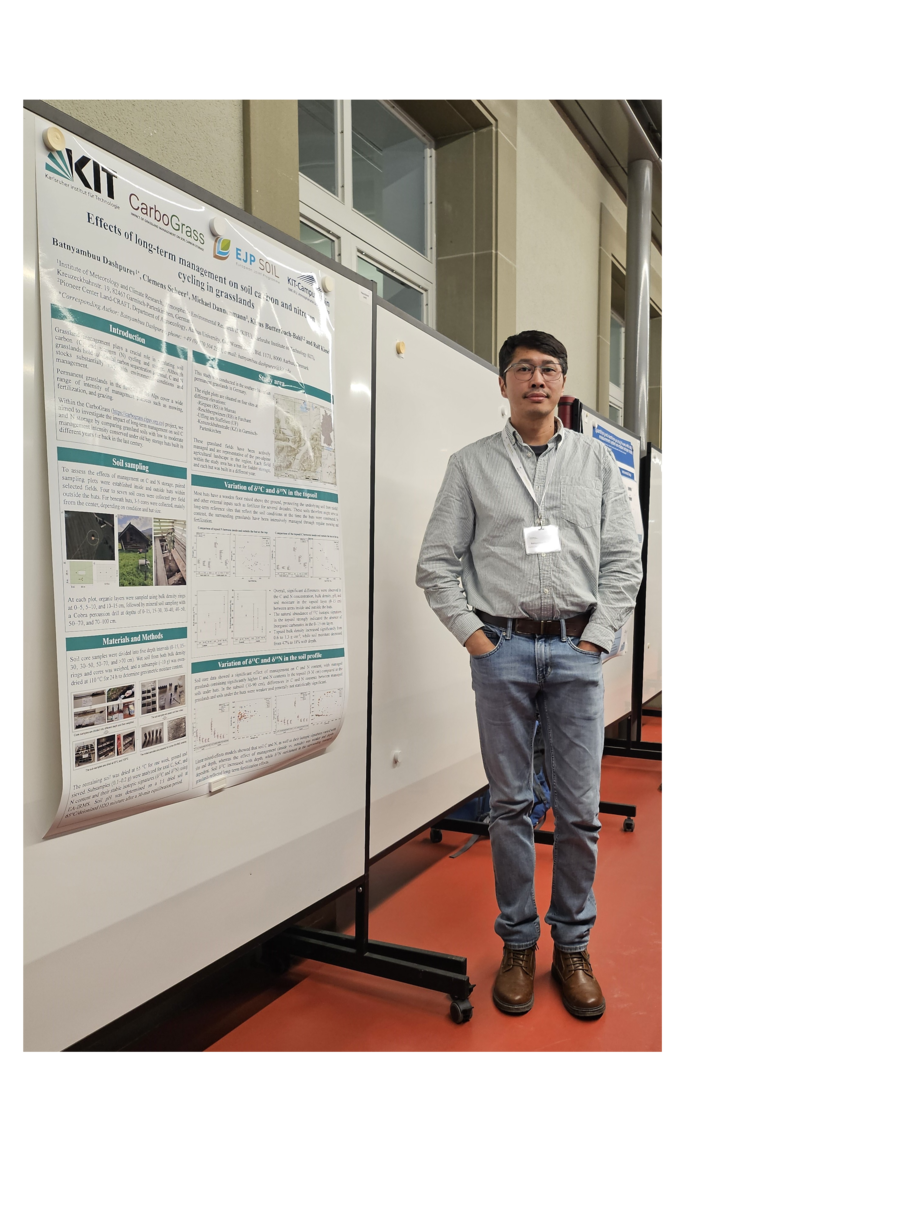
The project CarboGrass participated in the “STING26: Stable Isotope Meeting 2026” that took place in Bern, Switzerland on January 6-8, 2026 with the poster presentation titled “Effects of long-term management on soil carbon and nitrogen cycling in grasslands”. We presented preliminary results of the impact of long-term management on soil carbon and nitrogen storage by comparing managed grasslands with adjacent soils preserved beneath old hay storage huts of different ages in southern Germany.
C, N and GHG exchange in grassland session
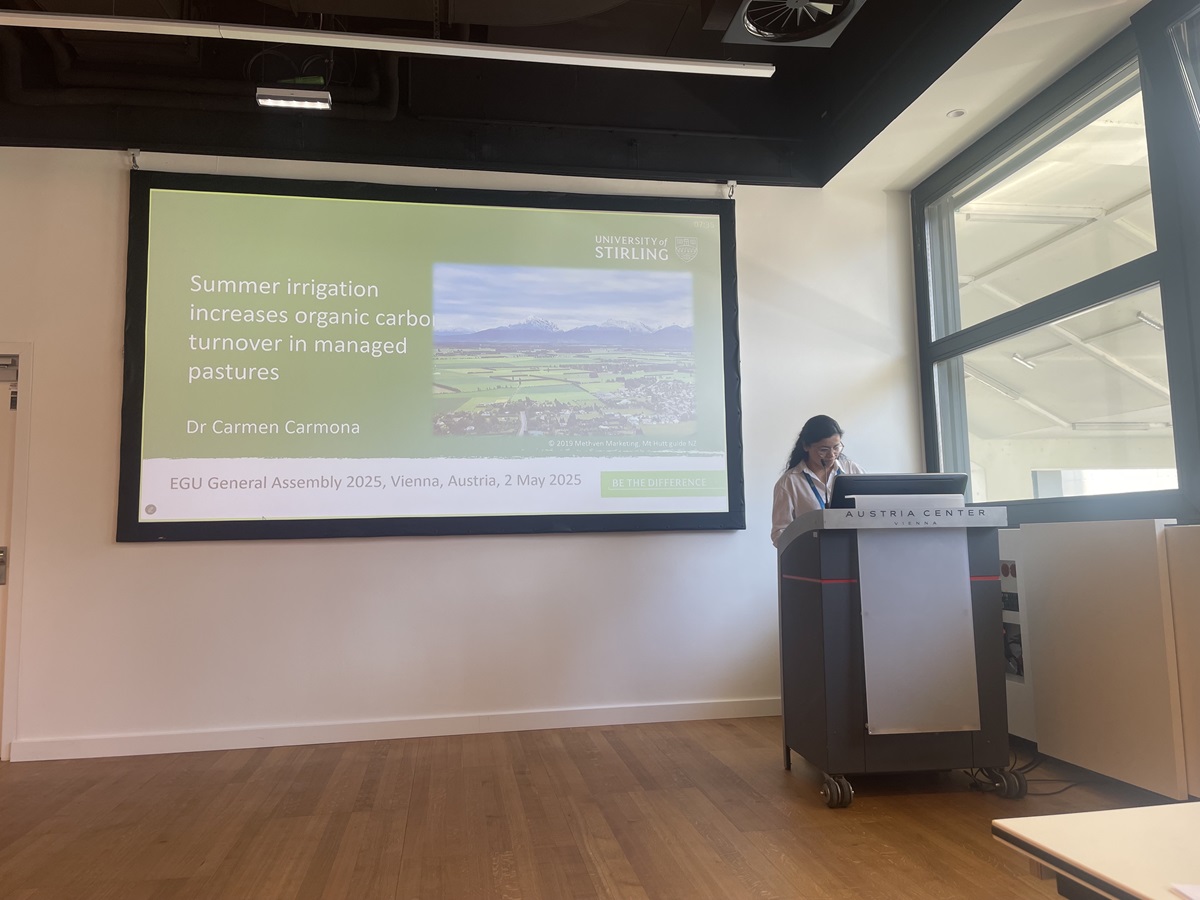
We are excited to share that a dedicated grassland Session BG3.36 at the EGU General Assembly 2025, part of the Carbon and nitrogen cycling and trace gas exchange in agricultural ecosystems session and co-organised and led by members of the CarboGrass project, was once again a resounding success, building on the positive reception of last year’s session! Held on May 1st (posters) and May 2nd (orals), the session spotlighted the critical role of grasslands, which cover approximately 40% of the Earth’s ice-free surface, in climate regulation, carbon sequestration, nitrogen cycling, and greenhouse gas mitigation. The session featured a diverse lineup of high-quality presentations, with contributions covering nearly every continent. Topics ranged from long-term greenhouse gas monitoring to the effects of irrigation, management practices, and the role of legume species in enhancing grassland productivity and C sequestration. The energy in the room was super, as researchers shared innovative approaches and findings on how sustainable grassland management can play a transformative role in addressing global climate challenges. We look forward to even more groundbreaking contributions in next year’s 2026 session!
CarboGrass Showcased at EGU General Assembly 2025 in ViennaDate: 1/05/2025
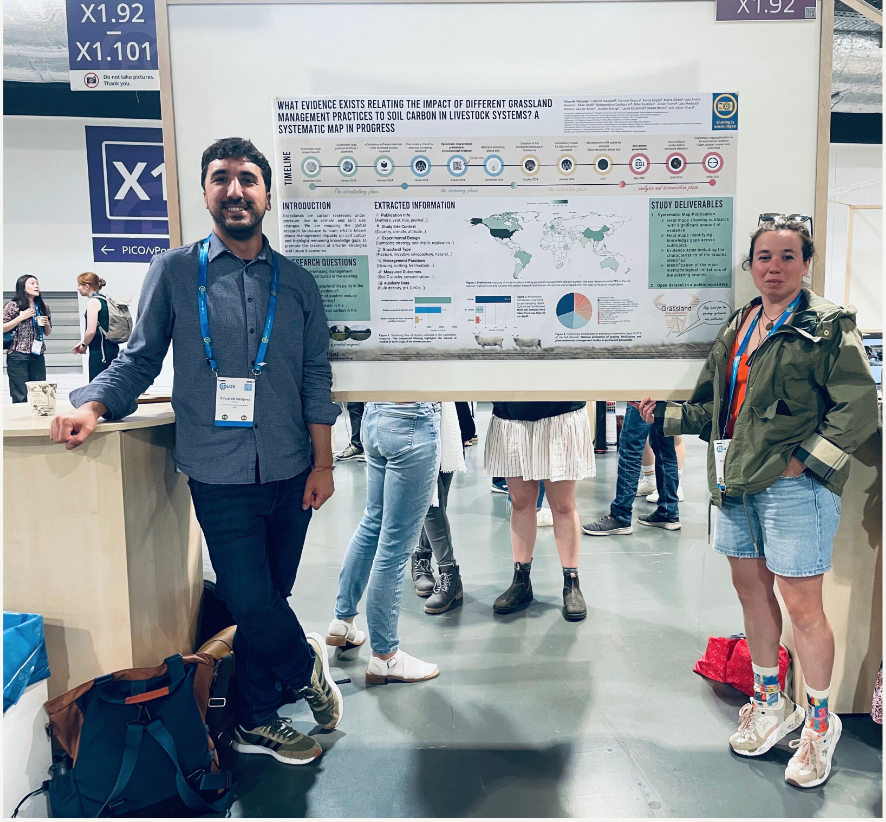
The CarboGrass project was proud to present its ongoing work at the EGU General Assembly 2025, held in Vienna, Austria from April 27th to May 2nd. Our poster, “What evidence exists relating the impact of different grassland management practices to soil carbon in livestock systems? A systematic map in progress”, was featured in the session on Carbon and Nitrogen Cycling and Trace Gas Exchange in Agricultural Ecosystems. (Abstract)We shared the methodology, timeline, and goals of our systematic map- (see Rousset et al. 2024 for more info), along with an exciting preview of early findings, representing 22% of the full dataset. The response from the scientific community was very positive, with strong interest in the approach and preliminary results. Eduardo Vasquez and Camille Rousset were energised by the feedback and discussions, which reinforced the relevance of this work in addressing key knowledge gaps in soil carbon and grassland management.
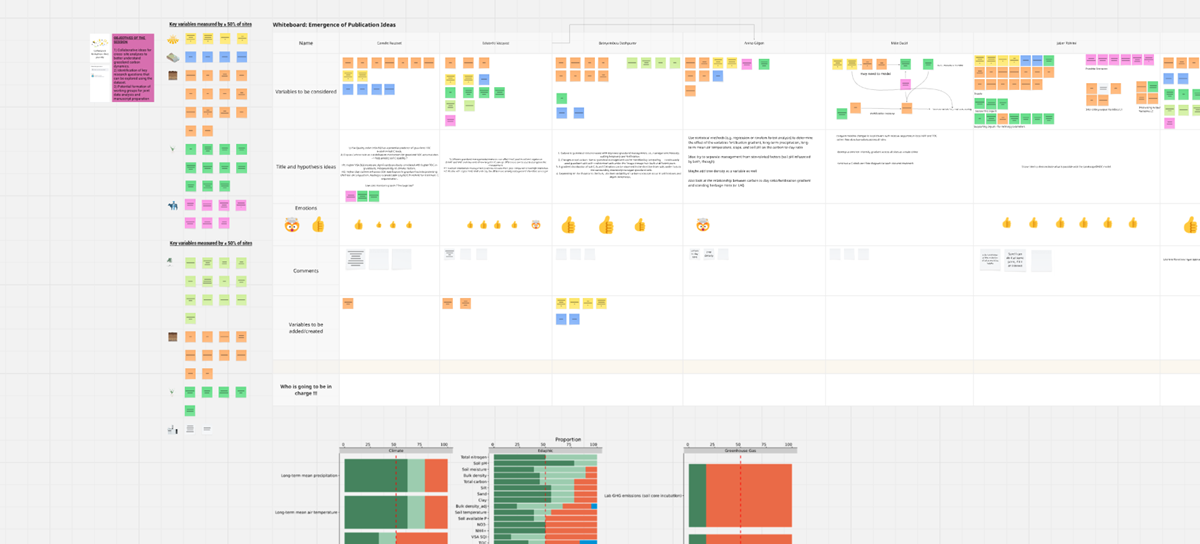
Internal CarboGrass data Hackathon session
CarboGrass members came together, both in person at EGU 2025 in Vienna and online, for an interactive and collaborative data hackathon session. A total of 10 participants explored the first compiled version of the CarboGrass dataset, which integrates data contributions from all participating teams across 20 farm sites worldwide.The 2h session began with a brief overview of the available variables, followed by an engaging brainstorming part, using an interactive whiteboard. Together, the group: The session had a productive discussion and laid a strong foundation for the next steps in data exploration and synthesis. This marks an exciting step toward unlocking the full scientific potential of this global dataset.
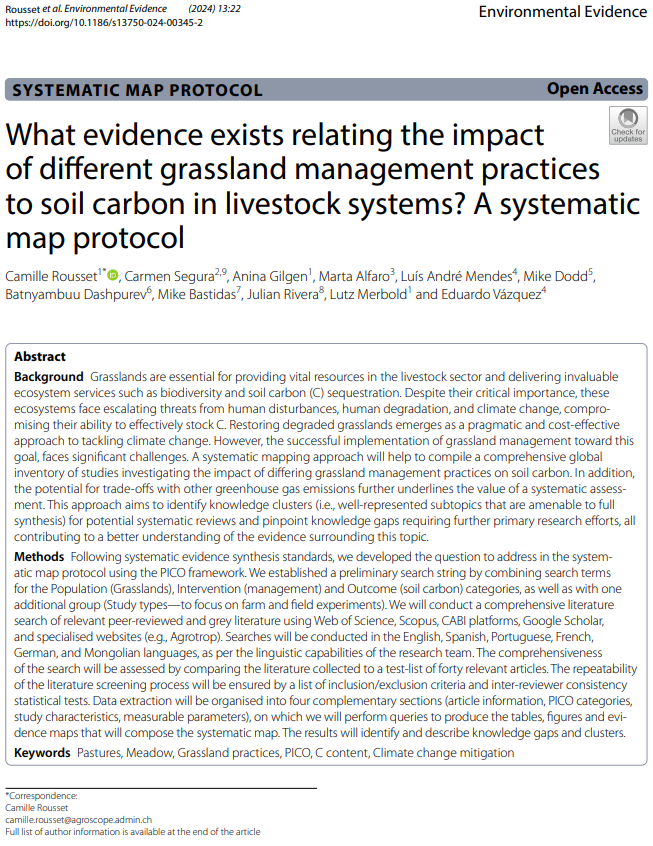
New Publication ALERT: What evidence exists relating the impact of different grassland management practices to soil carbon in livestock systems? A systematic map protocol
We are excited to announce the publication of our first research paper, which explores the critical role of grasslands in the global carbon cycle and their importance in mitigating climate change.Grasslands are vital for the livestock sector and deliver invaluable ecosystem services, including biodiversity conservation and soil carbon (C) sequestration. However, these ecosystems face increasing threats from human disturbances, degradation, and climate change, jeopardizing their capacity to effectively store carbon. Our study employs a systematic mapping approach to compile a global inventory of research on grassland management practices and their impact on soil carbon sequestration. This method allows us to: By providing a comprehensive evidence base, our work contributes to advancing sustainable grassland management practices and enhancing their role in climate change mitigation. Read more about the paper and its findings here
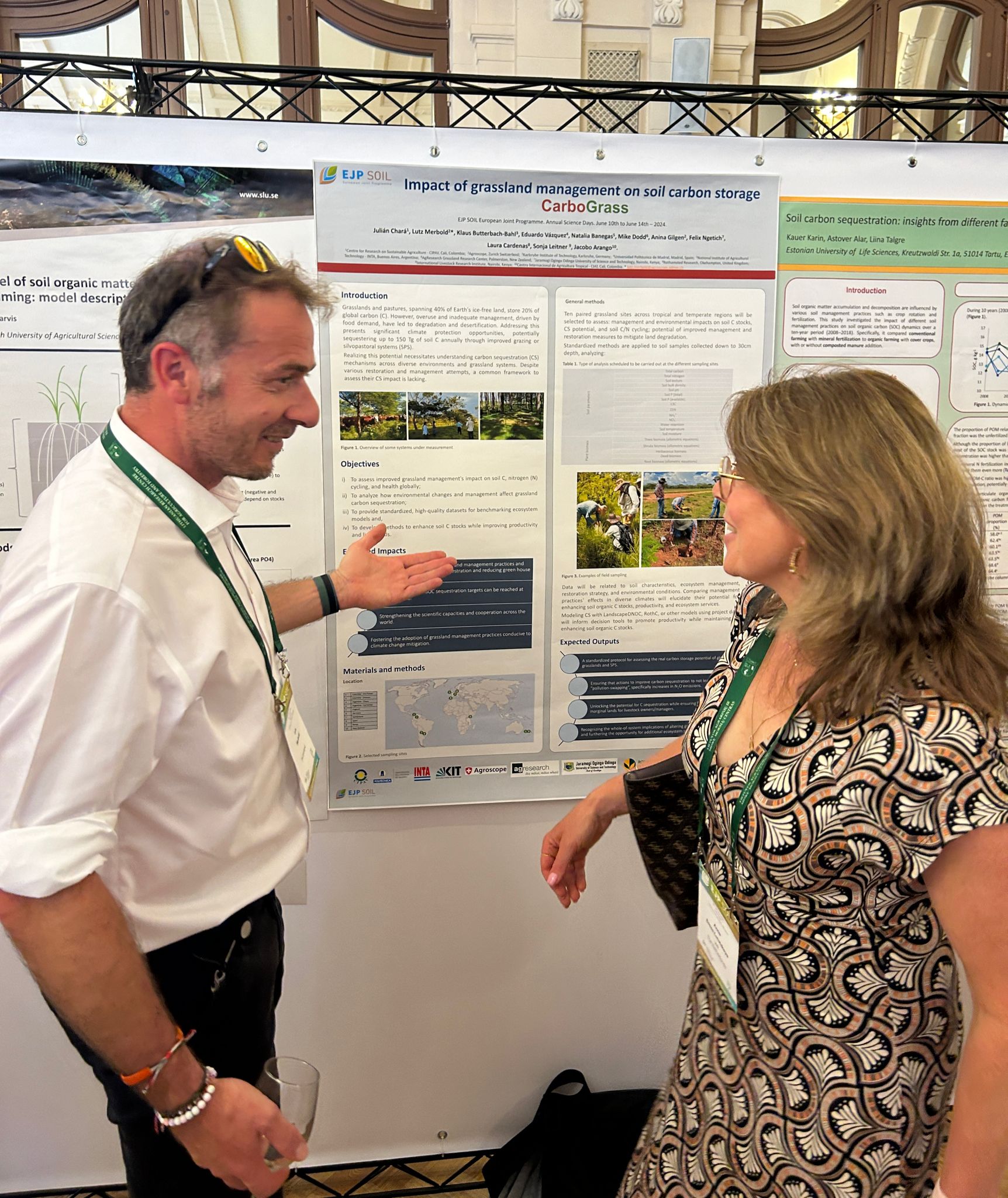
The project CarboGrass participated in the EJP Annual Science Days 2024
The project CarboGrass participated in the EJP Annual Science Days 2024 that took place in Vilnius, Lithuania on June 10-14 with the poster presentation “Impact of grassland management on soil carbon storage, CarboGrass” that presented a summary of the aims and methods applied for assessing the impact of improved grassland management and silvopastoral systems on soil C and N cycling.
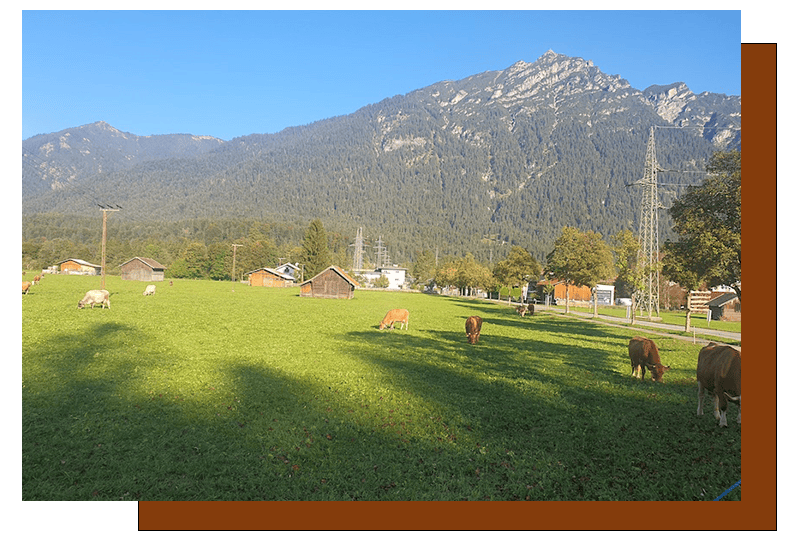
Impact of Grassland Management on Carbon and Nitrogen Cycling: Field and Modelling Studies
We are thrilled to announce that the session “Impact of Grassland Management on Carbon and Nitrogen Cycling: Field and Modelling Studies,” led by CarboGrass project members at the European Geosciences Union (EGU) conference, was a huge success! Grasslands, which represent 40% of the Earth’s ice-free surface, are vital for climate regulation, and this session showcased their incredible potential for carbon sequestration and greenhouse gas mitigation. The presentations were diverse and dynamic, covering a large spectrum of topics from innovative grazing strategies to the role of forage species and nitrogen regulation. The energy in the room was great as experts shared cutting-edge research on how sustainable grassland management can be a game-changer in our fight against climate change. This session took place on April 19th, 2024. More information can be found at https://environmentalevidencejournal.biomedcentral.com/articles/10.1186/s13750-024-00345-2.